

Are Resin Dice Worth the Cost? A 2026 Buyer's Guide
Table of Contents
- Resin Dice vs Mass-Produced: What Actually Drives the Price
- Resin vs Metal: Which Material Belongs at Your Table?
- How to Care for Resin Dice So They Last Through a Campaign
- Balance, Fairness, and the Artisan vs Factory Distinction
- Price Tiers: What You Actually Get at Each Budget
- Are Resin Dice Worth the Cost for Your Table?
- Frequently Asked Questions
Last Updated: September 20, 2026
Resin Dice vs Mass-Produced: What Actually Drives the Price
Resin dice are worth the cost when you value design, finish, and the feel of a set made with intent rather than stamped out by the thousand. We see this question constantly: are resin dice worth the cost, or are you just paying for prettiness? Price tracks three things: material, labour, and how many sets a maker can produce in a day.
Mass-produced dice come off automated lines: molds run continuously, pigment is mixed in bulk, and tumbling machines knock down edges quickly. That efficiency is why a basic polyhedral set sells cheaply.
Handmade resin dice work differently. A maker pours resin into individual molds in small batches, places inclusions, swirls, and layered colours by hand, then cures, demolds, and sands or polishes. Each step adds time, and time is the real cost driver.
That is the core distinction: mass-produced dice are priced by volume, while artisan resin dice are priced by attention. Canada Revenue Agency information for small businesses is a useful reference for anyone curious about how small Canadian makers structure their operations.
Resin vs Metal: Which Material Belongs at Your Table?
Metal dice win on weight and permanence. Resin dice win on variety, colour, and price. Neither is universally better, and the right pick depends on how you play, but the differences go deeper than most comparison articles admit.
Metal sets feel substantial in the hand, and the heft makes a roll feel consequential. The trade-offs are real: metal dice are louder, heavier to carry, and can dent a soft wooden table without a tray. They cost more per set, and a dropped d4 can chip a hardwood floor or crack a tile.
Resin dice feel lighter and warmer, and come in translucent, opaque, pearlescent, and sharp-edged styles, the aesthetic appeal is where resin cannot be matched. Want a d20 that looks like it has a galaxy trapped inside, or a set matching a character's cloak down to the exact shade? Resin is the only material that gets you there without a custom metal casting run.
Durability is the honest caveat. Resin can chip if dropped on tile, and cheap resin with trapped air bubbles can crack over time, though well-made, properly cured resin holds up for years. The failure mode differs from metal: metal dents and deforms, resin chips and scratches. A chipped metal die still rolls; a chipped resin die can develop a sharp edge that snags fabric and a visible flaw that ruins the set's look.
Here is the trade-off most articles skip: metal dice are effectively maintenance-free, while resin dice reward a little ongoing care. They can yellow under prolonged UV exposure, pick up scratches from loose storage, and translucent sets show every scuff. That is not a reason to avoid resin, just to budget for a pouch or tray alongside the set.
Weight also affects how a die behaves at the table. A heavy metal d20 lands with a thud and settles fast, satisfying to some, disruptive in a quiet room. A lighter resin d20 tumbles further and can roll off an unrimmed table. On a small surface or in a shared space, resin's lighter roll is often more practical.
| Factor | Resin | Metal |
|---|---|---|
| Weight | Light, warm | Heavy, cold |
| Noise | Quiet | Loud on hard surfaces |
| Durability | Chips, scratches, can yellow | Dents, deforms, can damage surfaces |
| Maintenance | Occasional care needed | Minimal |
| Aesthetic range | Very wide, colour, inclusions, translucency | Narrower, finishes and plating |
| Typical cost per set | Lower | Higher |
| Best for | Colour, character matching, quiet tables | Feel, permanence, display |
For most players, the decision comes down to what you value more: the sensory weight of metal or the visual range of resin.
How to Care for Resin Dice So They Last Through a Campaign
Caring for resin dice is simple: keep them dry, store them separately, and roll on a soft surface. Most damaged sets fail because of storage, not play. The difference between a set that looks new after three years and one that looks tired after six months comes down to a few habits most care guides never explain.
- Store dice in a soft pouch or a dedicated dice tray, ideally with each set in its own compartment
- Roll on felt, leather, or a padded mat rather than bare wood or stone
- Keep sets away from direct sunlight for long periods, since UV exposure can fade some pigments and accelerate yellowing in clear or translucent resin
- Wipe with a soft, dry cloth; avoid alcohol-based cleaners that can dull the surface
- Keep metal and resin dice in separate compartments
- Avoid leaving resin dice in a hot car or near a radiator, heat can soften resin and cause warping over time
Why Resin Yellows, and How to Slow It Down
Yellowing is the most common long-term complaint about clear and translucent resin dice, and it is worth understanding rather than fearing. The discolouration comes from the resin's chemical structure breaking down under UV light and oxygen exposure. It is not a sign the dice are cheap or defective, it is a natural aging process affecting all resin to some degree.
Repairing Light Scratches and Cloudiness
Surface scratches on resin are usually shallow and can often be improved with careful polishing. A soft cloth and a plastic-safe polish, the kind used for model kits or acrylic, worked gently in small circles can restore some clarity to a cloudy face. Avoid abrasive household cleaners or rough cloths, which make it worse.
What Not to Do
None of this is onerous. A pouch, a tray, and keeping dice out of direct sun covers 90% of long-term care. The remaining 10% is just handling them gently, which, if you spent good money on a set you love, you were probably going to do anyway.
Balance, Fairness, and the Artisan vs Factory Distinction
A well-made resin die can roll as fairly as any other die, but balance depends on how it was made, not what it is made of. That is the part most comparison articles skip.
Price Tiers: What You Actually Get at Each Budget
At the entry level, resin dice are genuinely affordable. The Ethereal Series - Red, for example, sits at $7.99 with a translucent, single-colour finish that reads as elegant rather than flashy, a fine choice for a first set or a trusty spare.

| Tier | Example Set | Price | Best For |
|---|---|---|---|
| Entry | Ethereal Series - Red | $7.99 | First sets, spares |
| Mid | Pearl Dragon - Crimson Flame | $11.99 | Everyday play |
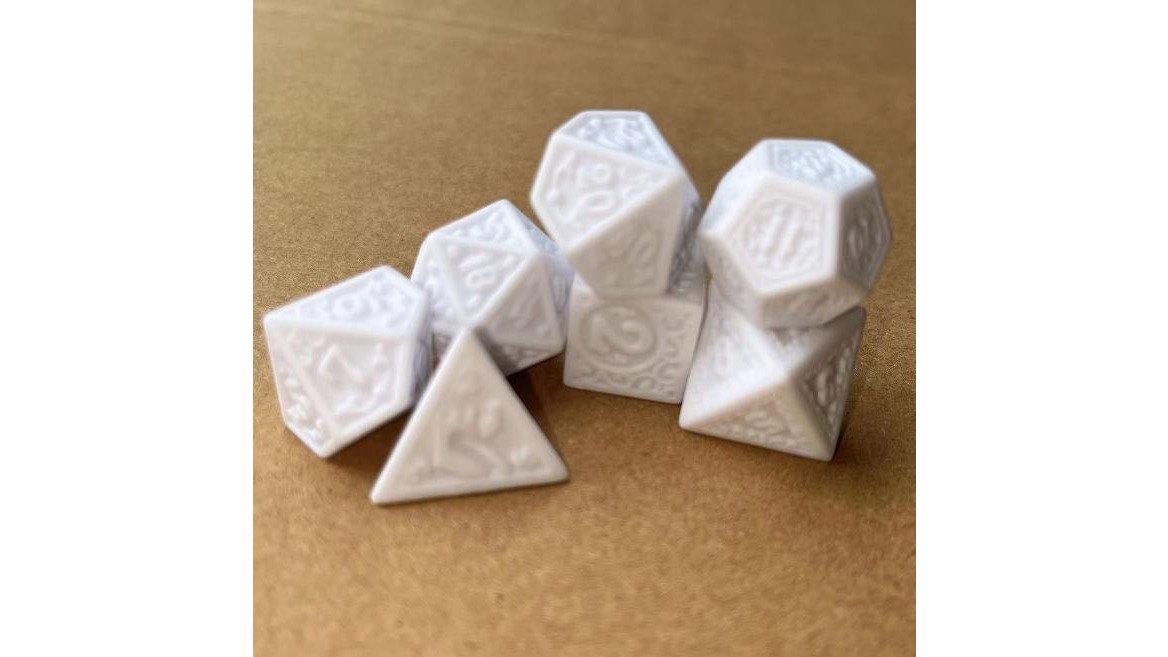
| Mid | Runeforge - Bonecarve | $11.99 | Bold, thematic tables |
| Mid | Elderscript - Unwritten Marble | $11.99 | Mystery-driven campaigns |
| Premium | Veinstone Series - Emerald | $29.99 | Collectors, showpiece sets |
Are Resin Dice Worth the Cost for Your Table?
If you are still weighing resin against other materials: resin dice are the most versatile for colour and inclusions, while metal dice are the most durable. Neither choice is wrong.

Frequently Asked Questions
Why are resin dice so expensive compared to acrylic sets?
The cost comes down to how they are made. Mass-produced acrylic dice are injection-molded in large runs, so the per-unit cost is low. Resin dice, especially hand-poured sets, involve mold preparation, pigment mixing, a curing period, and finishing work like polishing or inking. The Veinstone Series - Emerald at $29.99 reflects that premium resin and sharp-edge process, while the Ethereal Series - Red at $7.99 shows you can still get translucent resin dice without a collector-level price.
How do I care for resin dice to keep them from getting cloudy or scratched?
Store resin dice in a soft pouch or divided tray rather than loose in a hard box, since sharp-edged dice can scratch each other when they knock together. Keep them out of direct sunlight for long periods, because UV exposure can dull translucent finishes over time. Clean them with a soft cloth and mild soapy water, then dry them fully. Roll on a padded dice tray instead of bare wood or stone to protect the edges and your table.
Are metal dice better than resin for a regular campaign?
It depends on what you value. Metal dice have a weighty feel and hold up well over years of use, but they are heavier to carry and can dent softer tables without a tray. Resin dice are lighter, come in far more colors and finishes, and cost less at entry level. For most TTRPG players who want variety and portability, resin is the practical pick. Metal suits players who want heft and long-term durability.
Are handmade resin dice worth the premium price tag?
Handmade resin dice are worth it if you care about inclusions, custom designs, and one-of-a-kind finishes you will not find in mass-produced sets. The trade-off is price and a longer curing process behind each set. If you mainly need a reliable polyhedral set for weekly Dungeons and Dragons sessions, a mid-range resin set like Runeforge - Bonecarve at $11.99 delivers the tabletop experience without the artisan markup.